
 English
 русский
 Español

Input Voltage AC 100-240V 50-60Hz Working Voltage 24V (DC) Working Current 2A(max) Motor Type Brushless Motor No Load Speed 500 - 1350rpm Blade Material Stainless S...
See Details-
Electric Woodworking Saw
-
Multifunctional oscillating Saw
-
Power Drill

-
Rotary Hammer Drill

-
Impact Wrench

-
Electric Screwdriver

-
Angle Grinder

-
Handheld Pressure Washer

-
Handheld Lawn Mower
-
Lithium Turbo Jet Blower

-
Electric Pruning Shears
-
Lithium ChainSaw

-
Handheld Tiller Cultivator

-
Plant Watering Devices

-
Air Pump

Author: Admin Date: 2026-11-19
Hand Grinding Concrete: Practical Tools, Grits and Technique for Flat Floors
Field Notes · Concrete, Diamond, and Patience
Hand Grinding Concrete: The Patient Route to a Flat, Honest Floor
A 125 mm diamond cup, a steady pair of hands, and a slab that finally reads flat under a straightedge. This is how we approach concrete grinding when the work has to fit through a doorway, and what to get right before the wheel ever touches the floor.
Grinding by hand is the least glamorous part of concrete work and the step that quietly decides how everything after it looks. Do it well and coatings bond, patches disappear into the field, and thresholds stop catching boots. Rush it and every skipped pass will show in raking light for the next ten years.
What Hand Grinding Actually Does to a Slab
Hand grinding is simple abrasion, nothing more mystical than that. Diamond segments in a spinning cup scratch away cement paste and the tops of aggregate, taking high spots down to the level of the surrounding field. What turns it into a skill is knowing where to stop and how to keep the cut even across the whole surface.
- Flattening high spots, trowel ridges, and pour lines before a coating or overlay goes down.
- Removing paint, thin-set, adhesive, curing compounds, and failed sealers.
- Opening the surface so epoxy, self-levelling compound, or a patch can actually grip.
- Taking down trip hazards at joints, thresholds, and patched edges.
- Refining borders and small areas that a walk-behind machine cannot reach.
- Preparing a modest floor for densifier, sealer, or a full polish.
Where hand grinding stops making sense is scale. Walking backwards across a large open floor with a 125 mm cup is slow, dusty work, and an experienced hand might cover fifteen to twenty square metres in an hour on a clean, flat slab, and considerably less when the surface is hard-trowelled or coated. Past a few dozen square metres, a proper floor grinder earns its keep. Below that, the hand tool usually wins on set-up time, access, and control.
Before the First Pass: Prep That Saves Hours
Prep is where this job is won. A minute of checking beats an hour of wheel wear, and it keeps you from grinding a problem into a shine.
- Identify what is on the slab: curing compound, sealer, paint, adhesive, efflorescence. A glassy, reflective surface almost always has something on it.
- Check for cracks, hollow spots, and delamination. Grinding over a loose patch just polishes the edge of the problem.
- Tape plastic to walls and skirting, cover finished floors, and mask outlets and vents.
- Wash off chalk, dust, and loose grit so the first pass cuts concrete rather than dirt.
- Grind a one-square-metre test patch and look at it under a straightedge and a raking light before committing to the whole floor.
For that rinse step, a small cordless washer is plenty. You are cleaning, not stripping.
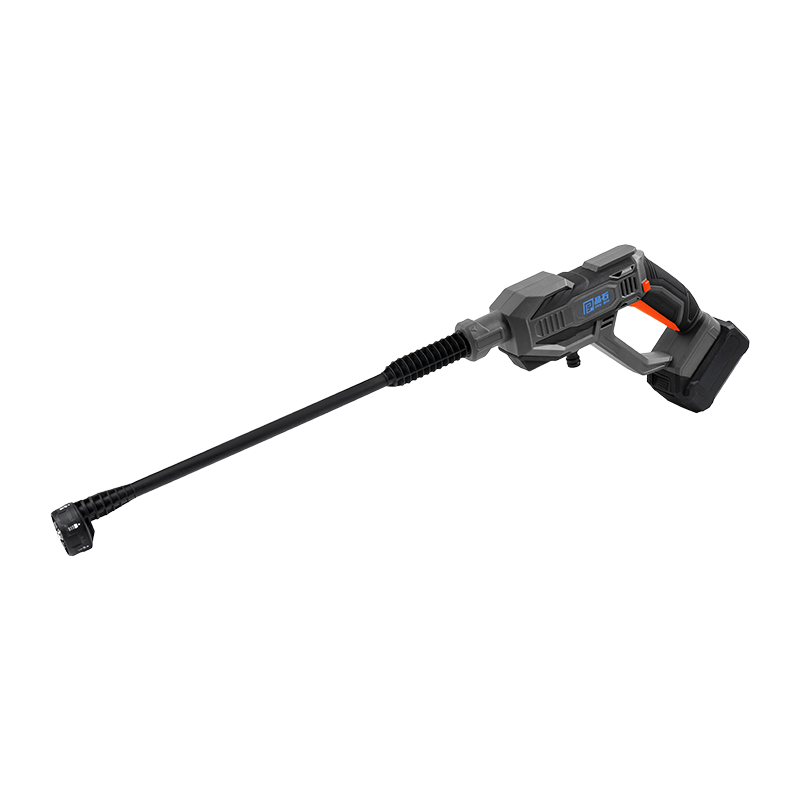 20V Cordless Pressure Washer for Portable Rinse CleaningA 2 kg handheld washer with 25 bar pressure, 2.8 L/min flow and self-priming, useful for the rinse step without a cable.View Product →
Let the slab dry properly if you plan to grind dry, or commit to wet grinding from the first pass. Switching between the two halfway through usually means slurry clogging the wheel and an uneven finish.
Choosing the Grinder and Setting It Up
Most hand grinding is done on a 115 mm or 125 mm angle grinder. The larger cup covers more ground per pass and cuts flatter; the smaller one is kinder on edges, corners, and tight doorways. On a big field, the difference in flatness is real, because a wide cup bridges high and low spots instead of following them.
Two features are worth paying for. The first is variable speed, since diamond tools have a working range and a fixed high-rpm machine is unforgiving on coatings and soft patches. The second is a motor that holds speed under load, because a grinder that bogs down glazes the surface instead of cutting it.
Power-wise, a corded machine from roughly 900 W upward keeps its pace through a long pass. A 20V brushless platform trades a little raw power for working without a cord, which matters on upper floors, outside, and anywhere the cable is more hazard than help. Our own 20V brushless angle grinder is built around that trade-off, with a body slim enough to follow a border without fighting your wrist.
 20V Brushless Angle Grinder with Variable SpeedCordless 8,500 RPM grinder with three speeds and a 4.0Ah battery, suited to following borders where a cable would get in the way.View Product →
Setting up is quick but worth doing properly: side handle fitted, dust shroud or water feed attached, cable routed behind you rather than across your feet, and the vacuum or hose close enough that you never have to step away mid-cut. Two hands on the tool, always.
Diamond Cup Wheels and Grit Progression
Grit sequence matters more than most people expect. A coarse wheel does the real levelling; finer wheels only refine what the coarse pass left behind. Trying to flatten a slab with a 120 grit cup is an exercise in polishing the top of a problem.
| Stage | Wheel | What it is for | Notes |
|---|---|---|---|
| Coarse (16–20 grit) | Segmented or turbo cup | Taking down high spots, removing coatings and curing compounds, opening the surface | This pass does the work; keep moving and overlap by a third |
| Medium (30–40 grit) | Double row cup | Blending coarse scratches and flattening the field | Reveals where high spots still sit |
| Fine (60–80 grit) | Fine cup or disc | Refining the surface for thin overlays and adhesives | Vacuum or rinse well between stages |
| Very fine (120–200 grit) | Fine cup or resin disc | Preparing for densifier, sealer, or polish | Only relevant when finishing, not just prepping |
| Polishing (400–3000 grit) | Resin pads | Gloss and clarity on decorative work | Needs water and a slow, light touch |
Workshop tip
If the cup starts skipping instead of cutting, it is usually glazed rather than worn out. Dress it by running it lightly across a strip of abrasive or a scrap of hard concrete, then carry on.
A Working Sequence, Start to Finish
- Walk the slab with a straightedge or a two-metre level and chalk the high points.
- Set up dust control before the tool starts, not after: water feed, or shroud and vacuum, whichever the wheel allows.
- Grind the edges and borders first, while you are fresh and the cup is sharp.
- Work the field in overlapping passes, moving side to side and stepping backwards, never parking in one spot.
- Cut a second pass at right angles to the first where the slab is out of plane; cross-hatching keeps the plane honest.
- Check with the straightedge every few square metres instead of at the end, when it is too late to change anything.
- Clean between grits and move on only when the previous stage has done its job.
Dust, Silica, and Looking After Your Lungs
Read this before you start
Concrete dust contains crystalline silica. Fine particles stay airborne for hours and settle in the lungs, and the damage does not heal. Dry grinding indoors without extraction is not a shortcut, it is a health decision made by accident.
Water-fed grinding is the simplest control: a steady flow at the wheel keeps dust in the slurry. A shroud paired with a proper vacuum and a clean filter runs a close second, provided the filter is not clogged and the hose is actually connected. Either way, wear a P3 or N100 respirator rather than a paper dust mask, plus eye protection, ear defenders, and gloves.
Grinders bite as well as dust. Let the wheel reach full speed before touching the slab, keep the tool moving, and do not lift a spinning cup out of the cut. Where you run a cup that requires the guard to come off, treat that as a deliberate risk decision and back it up with a face shield, dust control, and both hands on the machine.
If you are specifying tools for a crew rather than buying one for yourself, compliance is part of the specification, not paperwork on top of it. CE, GS, and EMC approvals each cover a different question, and our short primer on certification systems and market access walks through what each one actually means for a power tool.
Repairs, Coatings, and Problem Slabs
Grinding flattens; it does not fill. Spalls, hollow patches, and crumbling joints need repair before the wheel goes near them, otherwise you end up with a very smooth hole. Feathered patches should be ground flush once cured, not before.
Coatings are the other trap. Thick epoxy, mastic, and some sealers will load a cup within seconds and leave it smeared and useless. Soften what you can, scrape the bulk off, and take the residue with a coarse wheel at reduced speed and a light touch.
Where a repair needs stitching or anchor pins, drill the slots with a rotary hammer instead of forcing a grinder to do a job it was never designed for. A compact cordless unit is easier to handle at knee height and leaves cleaner holes for resin.
 20V Cordless Rotary Hammer with SDS Plus ChuckA compact brushless rotary hammer with 3.0 joules and four modes, useful for cleaner slot drilling before edge work.View Product →
Finishing, Sealing, and Edge Detail
Edges are where hand work beats machines, and also where it most often goes wrong. Run a smaller cup along the border with the tool supported, not tipped, and finish the edges before the field so you are not crowding a wall with a long wheel afterwards.
After the final grit, clean the surface thoroughly and let it dry to the manufacturer's schedule. A densifier followed by a sealer is the usual order for a working floor; a polish needs the finer stages and water. Skipping the cleaning step is the most common reason a sealer looks patchy a week later.
What good looks like
Flat under a straightedge, even in raking light, no swirl marks, no glossy burnished patches, and edges that read as part of the field rather than a separate strip.
Mistakes We See Most Often
- Starting with a fine wheel because that is the one already on the shelf.
- Pressing down hard. The weight of the tool is usually enough; pressure slows the motor and burns the surface.
- Grinding dry in an occupied building with no extraction.
- Skipping the test patch on a coated or sealed slab.
- Working one spot until it glows, then wondering why the floor is wavy.
- Forgetting that a dull cup polishes, and polishing is not the same as grinding.
Hand Work, Done Well
Hand grinding concrete is not fast, and it is not supposed to be. It is what you reach for when the machine will not fit through the door, when the area is small, or when the last two millimetres have to be exactly right. Get the grit sequence and the dust control right, work in overlaps, and check yourself constantly with a straightedge, and the results will hold up long after the dust has settled.
Most of the tools mentioned here, from brushless grinders to compact rotary hammers, come out of our workshop in Ningbo, where they are built and tested with exactly this kind of site work in mind. If you have a floor, a wheel, and a question, we are always glad to talk it through.

-
Feedback
Related Products
Related News
-
In the rapidly evolving landscape of construction, automotive repair, and industrial assembly, one tool has consistently stood out as the backbone of ...
READ MORE -
What Exactly Is an Electric Screwdriver Today? The shifting meaning of "electric screwdriver" in modern tool ecosystems The term "electric screwdriver...
READ MORE -
Impact Wrench: Definition and Core Working Principle The Impact Wrench, often referred to in industrial circles as an air gun, air wrench, or electric...
READ MORE
-
LINK
-
product
-
Quick Contact
-
 Building 1, Floor 1, Industrial Zone, Zhongyi Village, Guolin Town, Haishu District, Ningbo City, Zhejiang Province, China
-
 +86-13906619096
-
 Michael@chinashimu.com
-
KEEP IN TOUCH
Copyright© Ningbo Pinshi Electromechanical Co., LTD.
